
Published by Drug Driving Solicitors, specialist UK solicitors defending drivers facing drug driving charges.
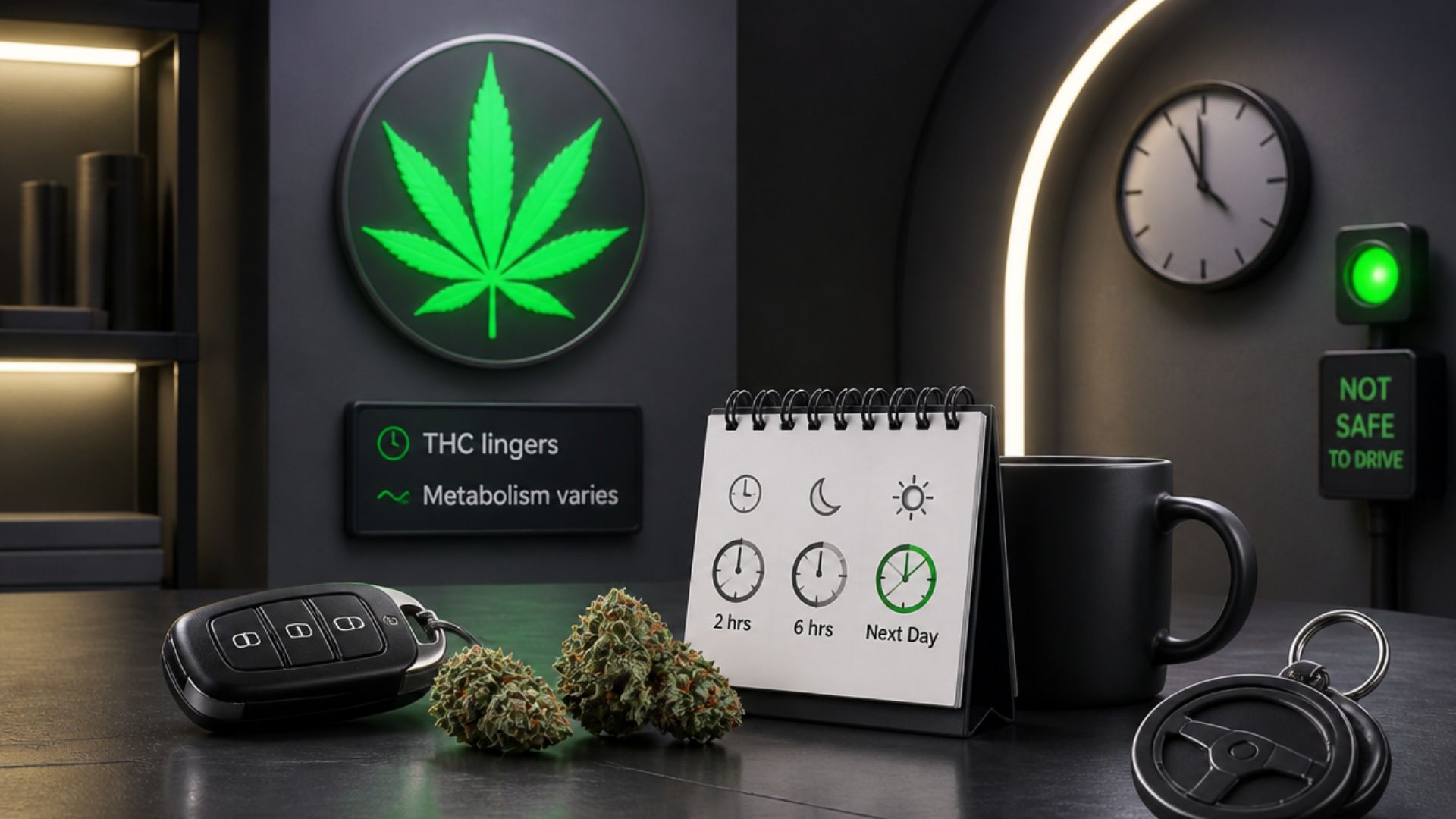
Still High Behind the Wheel? 6 Reasons You Might Be Over the Cannabis Limit the Next Morning
Feeling completely normal the morning after using cannabis does not necessarily mean that your blood THC concentration has fallen below the legal driving limit. THC behaves very differently from alcohol once it enters the body, and the time between using cannabis and feeling sober cannot be converted into a reliable estimate of what an evidential blood test would show.
In England, Wales and Scotland, Section 5A of the Road Traffic Act 1988 makes it an offence to drive, attempt to drive or be in charge of a vehicle with a specified controlled drug above its prescribed blood limit. For delta-9-tetrahydrocannabinol, or THC, that limit is 2 micrograms per litre of blood. The offence does not require the prosecution to prove that the driver was visibly impaired. Northern Ireland operates under different drug-driving legislation and does not use the same Section 5A specified-limit regime.
1. Edibles Can Change the Timing Completely
Cannabis does not enter the bloodstream according to one predictable timetable. Smoking and vaping deliver THC rapidly through the lungs, whereas edible cannabis must pass through the digestive system and undergo metabolism in the liver. That difference can substantially change when THC reaches its peak and how long the overall effects and elimination process take.
Oral Cannabis Has a Slower Start
When cannabis is inhaled, blood THC concentrations can rise within minutes. Oral THC generally takes considerably longer to reach peak blood concentrations, with research describing a delay of roughly two hours in some preparations and substantial variation between individuals. This means an edible consumed late at night may still be following a very different absorption curve from cannabis that was smoked earlier in the evening.
Food intake, dose, product formulation, and individual digestion can add further uncertainty. Two people consuming apparently similar edible products may therefore experience quite different concentration-time profiles. An assumption such as "I took it at 10 pm, so I will definitely be clear by 8 am" cannot account for all of those variables.
The Method of Consumption Matters the Next Morning
The practical issue is not that eating cannabis automatically leaves every driver above the legal limit the following day. Rather, oral consumption can delay absorption and make the timing more difficult to predict. Research has also shown that oral THC produces proportionally more of the active metabolite 11-hydroxy-THC than inhaled cannabis, further illustrating why different consumption methods cannot simply be treated as equivalent.
2. Feeling Sober Does Not Tell You Your THC Level
One of the easiest mistakes to make is treating the disappearance of the noticeable "high" as proof that THC has cleared from the bloodstream. Subjective intoxication and blood concentration are related only imperfectly, so how alert, relaxed or clear-headed someone feels cannot reveal whether their blood concentration is above or below 2 microgrammes per litre.
The Sensation Can Fade Before the Legal Issue Does
Cannabis affects perception, concentration, coordination and other functions through activity in the brain. As those noticeable effects diminish, a person may reasonably feel that the experience is over. Blood THC, however, follows a complex pattern of distribution and elimination that does not precisely mirror those subjective sensations.
Research examining THC concentrations, perceived intoxication, and driving-related performance has repeatedly found that the relationships between these measures are weak and inconsistent. A meta-analysis of 28 publications concluded that blood and oral-fluid THC concentrations were relatively poor indicators of cannabis-induced impairment, particularly among regular users.
Legal Concentration and Impairment Are Different Questions
This distinction cuts both ways. A particular THC concentration does not provide a perfect measure of impairment, but feeling unimpaired does not prove that the concentration is below the legal threshold either. Recent systematic reviews have similarly found that blood THC and driving performance do not have the straightforward concentration-to-impairment relationship seen with alcohol.
3. Frequent Use Can Leave Residual THC for Much Longer
Someone who uses cannabis frequently may begin with a very different baseline from someone who uses it occasionally. Repeated exposure can result in residual THC remaining in the body, meaning the concentration after the most recent use is influenced not only by that single session but also by the person's longer-term pattern of consumption.
Regular Users Can Have Residual Blood THC
This is not merely theoretical. A systematic review examining frequent cannabis users found that some participants still had blood THC concentrations exceeding 2 ng/mL, numerically equivalent to 2 micrograms per litre, after several days of abstinence. Some studies included in the review identified concentrations above that level after six days without further cannabis use.
That does not mean every frequent user will remain above the Great Britain driving limit for days. Cannabis pharmacokinetics vary substantially between individuals. It does mean that a simple rule based on the number of hours since the last joint, vape or edible can be especially unreliable for people who use cannabis regularly.
Yesterday's Use May Not Be the Whole Story
The body can retain THC after repeated exposure, and research involving chronic users has documented long terminal elimination phases associated with storage and subsequent release from body tissues. Consequently, the question in a drug-driving investigation is not necessarily limited to how long it has been since the driver's most recent use.
4. The Legal Limit Is Not a Test of Whether You Look Heavily Impaired
The cannabis threshold used for Section 5A offences is deliberately low. THC is subject to what government policy describes as a zero-tolerance approach, with the limit set high enough to allow for accidental exposure rather than at a concentration intended to represent severe or obvious intoxication. For cannabis, the specified level is 2 microgrammes per litre of blood.
Section 5A Does Not Require Proof of Impairment
This point is crucial. Under Section 5A, the prosecution does not have to establish that THC made someone weave across the road, react slowly or otherwise appear incapable of driving properly. The offence concerns whether the concentration of the specified controlled drug exceeded the applicable legal limit while the person was driving, attempting to drive or in charge of the vehicle.
There is a separate offence under Section 4 of the Road Traffic Act 1988 concerning driving while unfit through drugs. That offence focuses on impairment. Section 5A, by contrast, created a specified-limit offence precisely so that proving impairment is not required in every prosecution.
"Zero Tolerance" Needs a Small Qualification
Although government material describes the policy for cannabis and several other drugs as a zero-tolerance approach, CPS guidance makes an important technical distinction. The offence is not literally based on zero THC being present. The limits are deliberately low but contain sufficient tolerance to guard against claims based on accidental exposure. In practice, therefore, the legal question is whether the evidential concentration exceeds the specified 2 microgrammes-per-litre threshold.
5. THC Is Stored and Released Differently From Alcohol
THC is highly lipophilic, meaning that it readily distributes into fatty tissues. This is one of the reasons its pharmacokinetics cannot simply be compared with alcohol. After THC enters the bloodstream, concentrations initially fall rapidly as the compound is distributed into tissues and metabolised, but that initial decline is not the entire elimination process.
Fat Tissue Acts as a Storage Compartment
Research on cannabinoid pharmacokinetics has shown that THC can accumulate in adipose tissue and later be released gradually back into circulation. This contributes to the long terminal elimination phase seen particularly in frequent users. The body is therefore doing more than simply removing THC from the bloodstream at a steady hourly rate.
This helps explain why alcohol-style calculations are inappropriate. People sometimes think in terms of consuming a certain amount, waiting a fixed number of hours, and expecting the concentration to decline according to a predictable formula. THC distribution, redistribution, and individual patterns of use make that approach unreliable.
Clearance Is Not a Simple Countdown
The practical implication for next-morning driving is that time alone does not provide a guaranteed answer. Even once the obvious psychoactive effects have disappeared, residual THC may still be measurable, particularly after repeated use. A person cannot determine whether their blood is above or below the Section 5A limit simply by counting the hours since they last consumed cannabis.
6. Your Body Does Not Follow a Standard Clearance Timetable
Two people can consume similar cannabis products at similar times and still produce different blood concentration profiles. Dose and frequency of use matter, but so do differences between individuals, including metabolism and body composition. This variation makes a universal next-morning calculation unrealistic.
Metabolism and Body Composition Add Variability
THC is processed largely through the liver and distributed widely through the body. Genetic and physiological differences affecting metabolism can change the rate at which cannabinoids are processed, while differences in body composition may influence the way a highly fat-soluble compound such as THC is distributed and retained.
Body weight on its own is not a reliable indicator of blood THC concentration. A heavier person does not automatically clear cannabis more slowly, just as a lighter person cannot assume that they will clear it faster. The interaction between dose, frequency of use, metabolism, body composition, and route of administration is considerably more complicated.
Hydration Is Not a Reliable Shortcut
Hydration can influence the concentration of some biological samples, particularly urine, but drinking large quantities of water is not a scientifically reliable method of accelerating THC elimination from the blood. For a Section 5A allegation, the evidential issue is the concentration found in blood. Trying to "flush out" cannabis with water therefore does not provide any assurance that a driver will fall below the legal THC limit.
Why the Morning After Can Still Matter
Cannabis does not provide drivers with a dependable countdown clock. The route of administration, frequency of use, THC's storage in body tissues, individual physiology and the weak relationship between subjective sobriety and blood concentration all make next-morning predictions difficult. In Great Britain, the Section 5A offence ultimately turns on the evidential blood concentration rather than whether the driver believed the effects had worn off, which is why a morning-after allegation deserves careful examination of the evidence and procedure rather than assumptions based solely on how the driver felt.
Frequently Asked Questions
Does a Positive Roadside Swab Mean I Will Automatically Be Charged?
No. A roadside saliva test is a preliminary screening test, not the evidential result that by itself proves a Section 5A offence. Current roadside devices screen for cannabis and cocaine. Following a positive result, a suspect can be arrested and taken to a police station, where an evidential blood specimen may be required. The laboratory analysis of that specimen is used to establish the concentration relied upon in a prosecution.
A positive roadside result therefore does not automatically mean that a conviction will follow. Depending on the facts, issues may arise concerning the evidential sample, laboratory analysis, police procedure or other aspects of the prosecution case. Whether any particular issue provides a viable defence requires consideration of the evidence in that individual case.
Is There a Safe Number of Hours to Wait Before Driving After Using Cannabis?
There is no official number of hours that guarantees every person will fall below the cannabis driving limit. THC clearance depends on factors including frequency of use, dose, route of administration, and individual pharmacokinetics. These variables make cannabis very different from alcohol-style calculations based on a relatively predictable rate of elimination.
If someone has used cannabis, simply waiting until they no longer feel high cannot establish their blood THC concentration. A laboratory blood analysis is the reliable means of determining the concentration present in a particular specimen.
Can I Be Charged Even If I Was Not Driving Badly?
Yes. Section 5A is a specified-limit offence, so the prosecution does not have to prove erratic or impaired driving before an over-the-limit allegation can be brought. However, police powers to require preliminary roadside testing are not unlimited random-testing powers. Under the Road Traffic Act, a preliminary test may be required in circumstances including reasonable suspicion of alcohol or drugs, the commission of a moving traffic offence, or involvement in a road traffic accident.
Accordingly, someone might be investigated even if their driving appeared normal, but it would be inaccurate to say that police can require a cannabis swab during any routine stop without a statutory basis for the test.
How Long Can Cannabis Remain Detectable in Blood?
There is no single detection period that applies to everyone. Occasional use usually produces a much shorter blood-detection window than frequent or heavy use, but the exact duration depends on the dose, testing sensitivity, consumption method, and the individual's pattern of cannabis use.
Frequent users can present a very different picture. A systematic review found that some frequent cannabis users remained above 2 ng/mL of blood THC after extended periods of abstinence, including several days in some studies. That does not establish a standard detection period for regular users, but it demonstrates why fixed estimates should be treated cautiously.
Does It Matter If the Cannabis Was Obtained Legally Abroad or Used Medically?
Using cannabis recreationally in a country where it was lawful does not create an automatic defence to a later Section 5A allegation in Great Britain. The issue is whether the specified controlled drug was above the applicable limit while the person was driving or otherwise falling within the offence.
A statutory medical defence can apply in appropriate circumstances where the controlled drug was lawfully prescribed or supplied for medical or dental purposes, was lawfully possessed, and was taken according to the relevant directions and accompanying instructions. The defence is not available where the person's actions were contrary to applicable advice about driving. This is more specific than simply saying that cannabis was being used for "medical reasons".
Similarly, unknowingly consuming a CBD product containing THC does not automatically create a defence if an evidential blood concentration exceeds the legal threshold. The circumstances would need to be considered individually.
What Should I Do If I Am Charged After Using Cannabis the Night Before?
Seek specialist legal advice as early as possible. The exact chronology of use, the product and consumption method, what happened at the roadside, the circumstances in which testing was required, the blood-taking procedure and the laboratory result can all be relevant to assessing the prosecution evidence.
A next-morning cannabis case should not be assessed solely on the assumption that a positive result automatically proves every element of the offence. Equally, simply feeling sober is not itself a defence. Specialist advice can identify which factual, procedural or scientific issues genuinely matter in the particular case.
Drug Driving Solicitors focus on defending motorists facing drug-driving allegations across the UK. If you have been charged following a cannabis result above the legal limit, contact us for a free and confidential initial consultation about your case.